Free to Change
We are entering what we call in Hawaiʻi “hurricane season.” It began with Fausto, now Genevieve is being watched, and so starts the familiar rhythm of storm tracking, flood advisories, high surf warnings, and that quiet hum of readiness that settles over the islands from June through November.
In 1992, Hurricane Iniki devastated Kauaʻi. Six people died. Thousands of homes were damaged or destroyed. The island lost power, and life changed overnight. Even today, Iniki has never entirely left us. Whether people lived through it or simply inherited the collective memory, the moment a storm gets a name, the island becomes alert. Costco fills with people buying bottled water, batteries, and supplies.
That alertness is earned. This community remembers, and remembering is not weakness.
I believe in being prepared. I carry insurance on my car. I schedule my medical screenings. I keep emergency supplies at home. These are wise expressions of responsibility.
What I am not aligned with is certainty—speaking as though the future has already been decided.
I do not carry insurance because I believe I am destined to have an accident. I do not schedule a mammogram because I expect cancer. Likewise, I can prepare for a hurricane without becoming convinced that one is coming.
Lately I have heard people say, “We’re definitely getting hit this year.” Some are already boarding windows. Others are encouraging neighbors to do the same. If the time comes, I will gladly prepare alongside everyone else. But I do not want to spend weeks living inside a storm that has not yet formed.
This is where spiritual teaching is often misunderstood. I will never say that someone “thought” a hurricane into existence or somehow created an illness through fear. That isn’t responsibility—that is blame disguised as spirituality, and it has wounded too many sincere people.
At the same time, I cannot believe we are merely spectators watching life happen around us. I believe consciousness is creative. I believe we are part of Nature, not separate from it. We participate in life. We influence it, and it influences us. What happens collectively belongs to all of us—not as individual fault, but as shared responsibility.
That distinction matters. Blame asks, Who caused this? Responsibility asks, What can I contribute now? I am interested only in the second question.
I also believe prayer matters. Gregg Braden tells the story of a Native elder who prayed during a drought, not by asking for rain but by entering the feeling of rain—smelling the wet earth and experiencing gratitude as though it had already arrived. What inspires me is the difference between praying toward something and praying from it. That distinction changes us.
Years ago I experienced a torn retina. As I reflected on that experience, I recognized something deeper. My life had been pulling me in too many directions. I had been saying yes when I meant no. My body seemed to be expressing what I had ignored emotionally.
I do not offer that as a diagnosis for anyone else. It is simply my experience. But I do know this: our bodies are not separate from the lives we live. Chronic stress changes us physically. Spiritual practice simply invites us to ask another question:
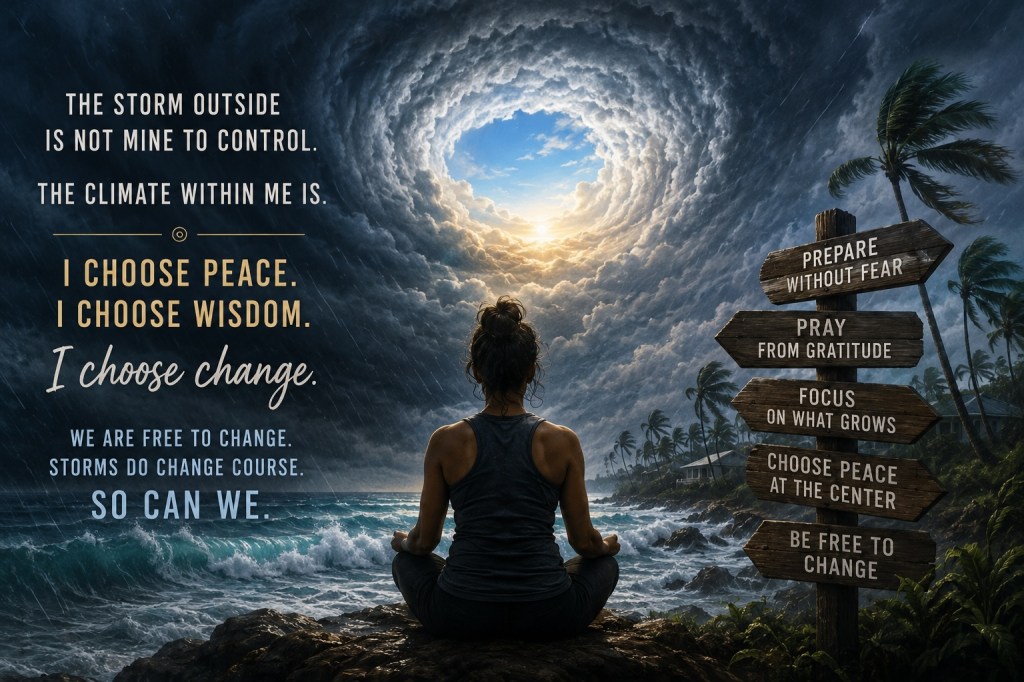
The storm outside is not mine to control. The climate within me is. That inner weather matters. The constant rehearsing of disaster. The endless scrolling through frightening headlines. The quiet bracing for something terrible to happen. Those habits shape our experience far more than we realize.
Science of Mind teaches that thought, energized by feeling, becomes creative. We live in a responsive universe. What we consistently give our attention to expands in our experience.
So why do we find ourselves predicting disaster? Perhaps because a hurricane is a fear we can actually do something about. We can buy water. Fill the gas tank. Charge our phones. Compare that with many of the challenges facing our world today—grief, division, uncertainty—where we often feel powerless. I understand the temptation.
When the news becomes overwhelming, I turn toward creativity. I write. I sing. I pray. Those choices do not deny reality; they preserve my ability to contribute something meaningful to it.
Even hurricanes teach us something remarkable. Every hurricane has an eye. At the center of tremendous force is extraordinary stillness. That calm does not exist despite the storm. It exists because of it.
I believe each of us carries a place like that within ourselves—a center untouched by disappointment, illness, fear, or loss. Ernest Holmes described it as a mind “poised in peace and beauty.” That peace is not dependent upon circumstances. It is a decision about where we choose to stand.
Every season I think about Iniki. For days, meteorologists believed it would pass south of Kauaʻi. Then the storm unexpectedly turned north, giving the island less than twenty-four hours’ warning before making landfall.
That story reminds me of something profoundly hopeful. The future is not settled. Storms can change course. Lives can change course too. The conversations we replay in our minds, the identities we have accepted, the decisions we have labeled permanent—those can all change.
I also want to acknowledge something we do not say often enough. Change is rarely easy. For years I have said, “Change your mind; change your life.” I still believe it. But changing your mind often costs something. It may cost familiar relationships. It may require releasing identities that once protected you. It may ask you to surrender a story you have carried for decades.
Every meaningful change I have made created turbulence before it created freedom. I would make every one of those choices again. Transformation is not difficult because it is false. It is difficult because it asks us to become someone new.
This piece is called Free to Change because I believe that even in our most frightened moments there is always an opening. There is always an eye at the center of the storm where wisdom, peace, and clarity already exist. When we learn to stand there, our fears loosen their grip. The winds may continue for a while, but they no longer define us.
We truly are free to change. Just as hurricanes can suddenly weaken, turn, or disappear altogether, so can the storms within us. We create our future one thought, one choice, and one courageous act at a time. Everything can get better. Storms do change course. What we focus on grows. The question is not whether change is possible. The question is whether we are willing to give ourselves permission to change.
Dr. Rita Andriello-Feren, Author, Co-Founding Spiritual Director, CSL Kaua’i


