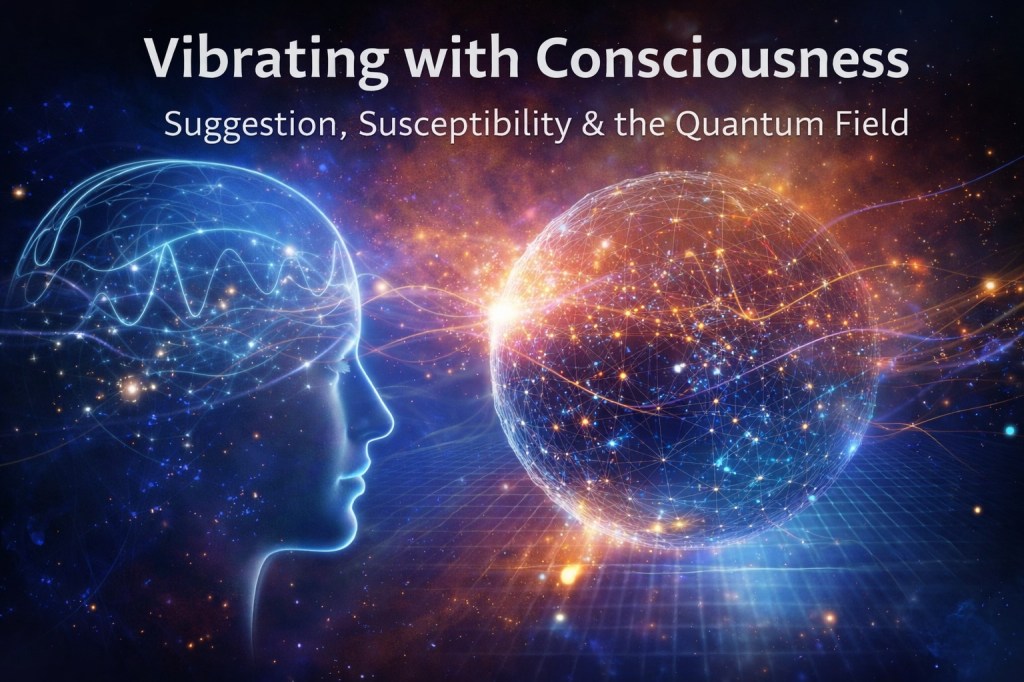
Recently, I’ve been immersed in Ernest Holmes’ Science of Mind, contemplating his teachings on the subjective mind and race consciousness. He writes about our susceptibility to suggestion according to what we vibrate with. He says that if we could observe the field of consciousness, it would be like a picture gallery of every experience and thought that has ever occurred across time. That’s a lot to comprehend, and it helps explain why we repeat patterns throughout the history of the race.
Well, let me ask you this: Who’s thinking you? Are your thoughts original, or are you vibrating with a larger field? These are the premises we are dealing with when studying the Science of Mind according to Ernest Holmes:
- The subjective mind is creative and receptive.
- Race consciousness is the accumulated human thought patterns.
- We are susceptible to suggestion according to our vibration.
- What we emotionally accept becomes law for us.
Let me explain what he means by “it becomes law for us.” The subjective mind is our use of the Universal Subjective Mind. It has no volition. The subjective mind does not reason — it responds. We all carry cultural beliefs about aging, money, and illness. We unconsciously agree with these beliefs until we become aware of them. These beliefs influence our perceptions and shape what we accept as possible for our lives. Becoming conscious of what we have unconsciously believed allows us to rise above the consciousness of the race into a new order of being. In other words, we can overcome what has been handed down to us. This is personal evolution.
I am not trying to prove metaphysics with quantum physics; I am exploring parallels. Quantum physics tells us that reality is made of fields of energy. Particles arise as excitations of those fields. So, just as matter arises from fields, experience arises from patterns in consciousness. In science:
- Systems resonate when frequencies match.
- Coherent systems amplify coherence.
In life:
- We are influenced by the emotional and mental tone around us.
- Social contagion is real.
- Nervous systems entrain.
We do not catch thoughts magically. We neurologically and psychologically entrain to patterns around us. Quantum mechanics does notsay your thoughts create parking spaces. However, your attention does stabilize patterns, and neural pathways strengthen with repetition. Your beliefs shape your perception. Holmes may have intuited something profound about how consciousness stabilizes experience.
So, what are you resonating with during these times of chaos and upheaval on Earth? This moment did not appear out of nowhere. It is the accumulation of centuries of race consciousness — the repetition of war, power struggles, dominance, and fear. Are you resonating with fear? With outrage? Or with creativity and the power of Love?
Holmes would say you are susceptible to the suggestions you sympathize with. Modern science would describe this as your nervous system stabilizing around repeated patterns. So, the real spiritual practice becomes this: cultivating coherence. This is Sowing the Sacred. This is tending your inner field.
We are not victims of race consciousness. We have volition and choice. We can be nodes of influence within it. In network science, a node is a point within a system that both receives and transmits signals. It is not passive. It affects the whole. You, as a coherent individual, influence the field. If enough of humanity entrains in collective moments of coherence, cultural tipping points can occur.
So, the question for all of us is: What field are we feeding? What frequency are we strengthening? Are you unconsciously susceptible — or consciously resonant? The more coherent we become, the less susceptible we are to unconscious suggestion — and the more powerful we are as conscious creators.
I am thinking about the Renaissance — the light that emerged from what we call the Dark Ages. There was a definite shift. The phoenix does rise from the ashes of chaos. There was a time when Europe could not imagine itself out of plague, war, and collapse. Old structures were failing. Authorities were losing credibility. Explanations no longer soothed the human soul. And then something extraordinary happened. Not everywhere. Not all at once. But in pockets — in Florence studios, in workshops, in minds willing to ask new questions — imagination began to outpace fear. The Renaissance did not begin with armies. It began with artists. With thinkers. With patrons who funded vision instead of violence. It began when the human being dared to see itself differently.
Now fast forward. Quantum science tells us that reality is not a fixed machine; it is a dynamic field of potential. Systems theory tells us that when structures destabilize, new attractor states become possible. When a system destabilizes — when fear narratives reach saturation — when the old story exhausts itself — that is not only collapse. It is potential. The Renaissance was a shift in the story of what it meant to be human. The question before us now is: What story are we stabilizing? Are we stabilizing the story of war? Of power struggles? Of scarcity and dominance? Or are we stabilizing a new human narrative — one of creative intelligence, interconnection, and shared evolution?
Centuries later, during industrial expansion and moral tension, the Transcendentalists stepped forward: Emerson, Thoreau, Margaret Fuller. They declared something equally radical: Authority is not external. Truth can be accessed from within. They shifted the center of gravity from institutions to intuition. The Renaissance liberated the intellect. Transcendentalism liberated the inner life.
New Thought was itself a kind of Renaissance. It declared: You are not a victim of fate. You are not bound by inherited limitation. You are a center of creative consciousness. Quantum physics does not say your thoughts magically rearrange the cosmos. But it does reveal that the universe is not solid and finished. Holmes does not deny collective influence. But he insists that each individual can choose what they resonate with. And history shows us: enough individuals imagining differently can shift an era.
There have been two moments in my life when I reached a limit. The first was when I left home at eighteen. I wasn’t running from something. I was moving toward something. I could feel that if I stayed, I would become smaller than I was meant to be. So, I left. The second was when I realized I had reached the edge of what I could experience within my marriage. There was no villain. No dramatic explosion. Just clarity. I had grown to the boundary of that structure. And once growth reaches the boundary, something has to change. Both moments felt destabilizing. Both disrupted the system of my life. But they were not collapses. They were bifurcation points. The old pattern could no longer sustain the level of consciousness that was emerging. Staying would have meant contraction. Leaving created possibility. That’s what a bifurcation point is.
When the old structure cannot hold who you are becoming — and returning is no longer an option. Evolution doesn’t always look graceful. Sometimes it looks like walking away. But what appears to be an ending is often reorganization at a higher order. That was not destruction. That was emergence.”
We are not here to escape dark times. We are here to imagine at the edge of them. Just as Renaissance artists did not wait for the world to be safe — they painted anyway. Just as scientists did not wait for permission — they inquired anyway. Just as Holmes did not wait for a culture ready for metaphysics — he taught anyway.
So perhaps the real spiritual question is not: Are we in a dark age? But: Are we willing to fund — with our attention, our creativity, our coherence — the next Renaissance? Because systems shift when enough nodes stabilize a new pattern. And you — each of you — are a node in the field of human consciousness.
If quantum reality is a field of potential, and race consciousness is a field of accumulated thought, then the future is not something that happens to us. It is something that stabilizes through us. Perhaps this moment in history is not a descent. Perhaps it is a threshold. A bifurcation point — a moment in a system when small changes cause a sudden shift into a new pattern or direction. When old structures become unstable and the system can no longer return to its previous state, multiple new possibilities open up. Think of water as it boils. At a certain temperature, it transforms into steam. Bifurcation is the trembling before emergence. And maybe — just maybe — the Renaissance we are waiting for is waiting for us.
Blessings,
Rev. Dr. Rita Andriello-Feren, Author, Co-Founding Director CSL Kaua’i, Institute of Magnificence, Partners in Empowerment

 Love Changes everything